Research
Publications
-
NeurIPS 2026 · Main Track
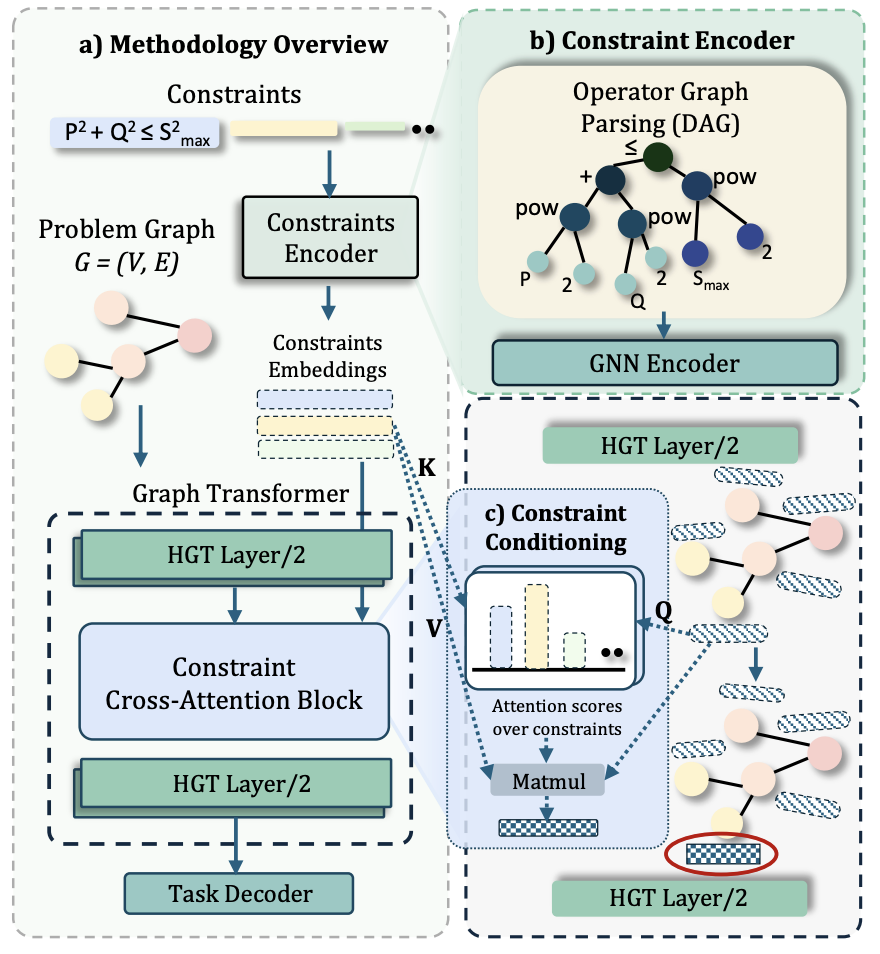
CONSTRAINER: Promptable Graph-Structured Optimization via Constraint Conditioning
CONSTRAINER is a constraint-conditioned foundation model for graph-structured optimization. An operator-DAG constraint encoder conditions a heterogeneous graph transformer through cross-attention. It transfers zero-shot to DC optimal power flow and reaches 99.02% feasibility.
Foundation Models×Graph Neural Networks×Constrained Optimization
Conference Manuscripts
-
Under review · ICLR 2027
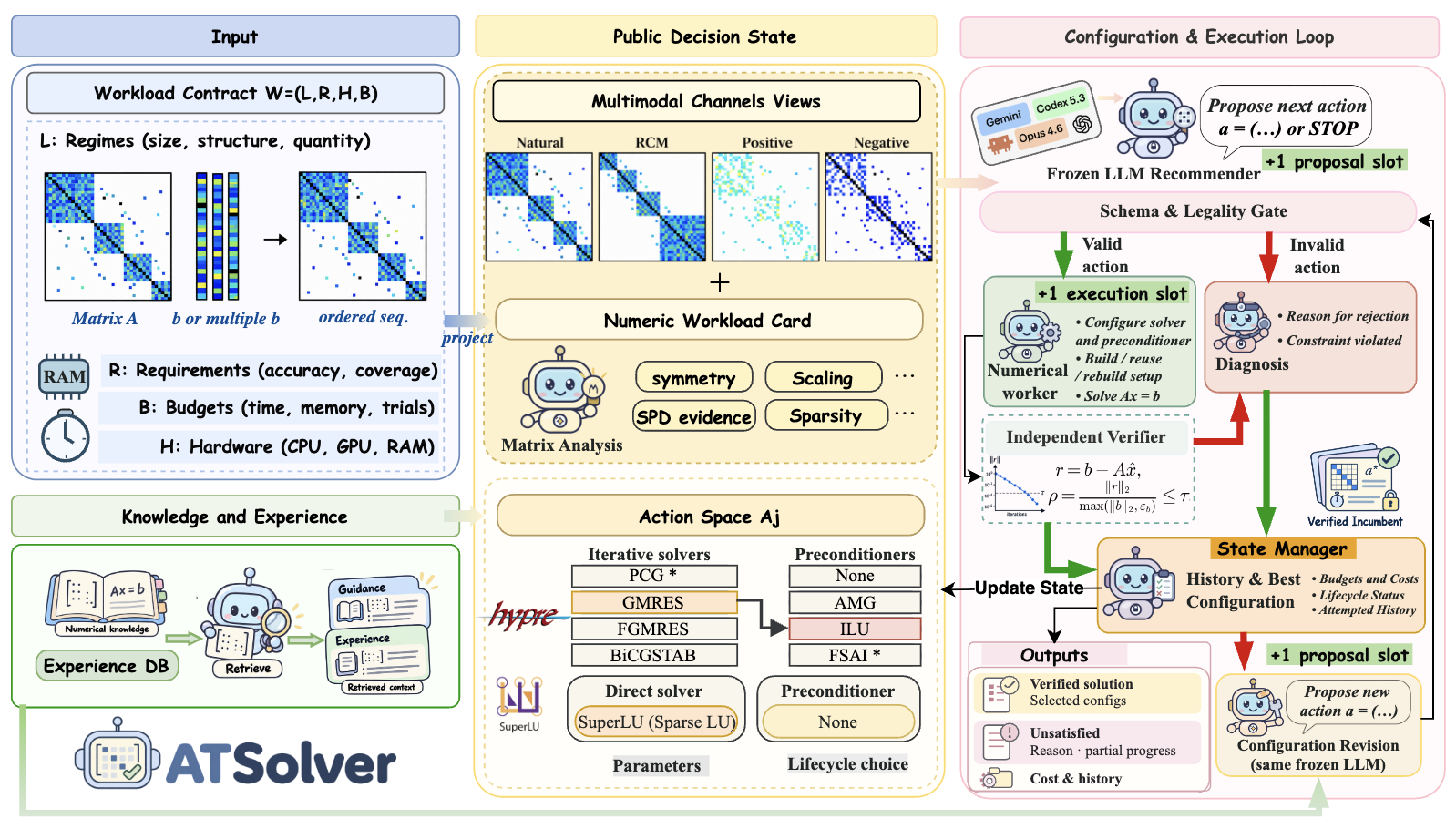
ATSolver: Agentic Tuning of Sparse Linear Solvers with Numerical Feedback
ATSolver is a verifier-grounded framework for agentic sparse-solver tuning: a fixed language model proposes typed solver configurations, and trusted numerical software executes and verifies them. Under matched six-proposal budgets it accepts 75/105 runs versus 64/105 for independent Best-of-6, with 30.1% lower replayed solve time.
Agentic AI×LLM Agents×Scientific Computing
-
Under review · AAAI 2027
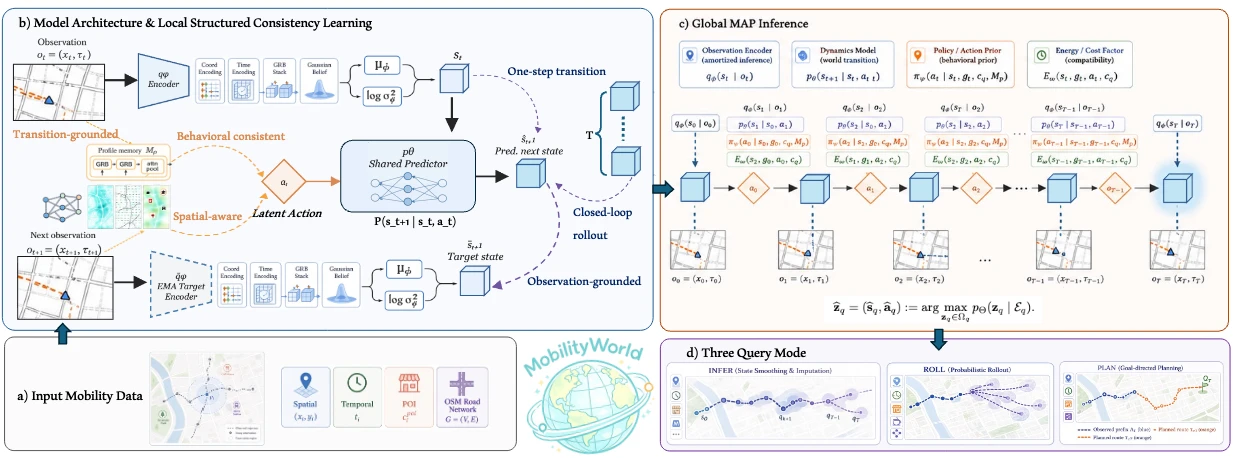
MobilityWorld: Learning a Structured World Model for Human Mobility via Latent State-Action Dynamics
MobilityWorld is a structured world model that recovers latent states and latent actions from sparse GPS traces, grounded in the road and POI network. One checkpoint per dataset supports inference, closed-loop rollout, and graph-executable planning across eight tasks, reaching 82.3 m five-step ADE on GeoLife and 0.902 staypoint F1 on Atlanta.
World Models×Latent Dynamics×Human Mobility
-
Under review · AAAI 2027
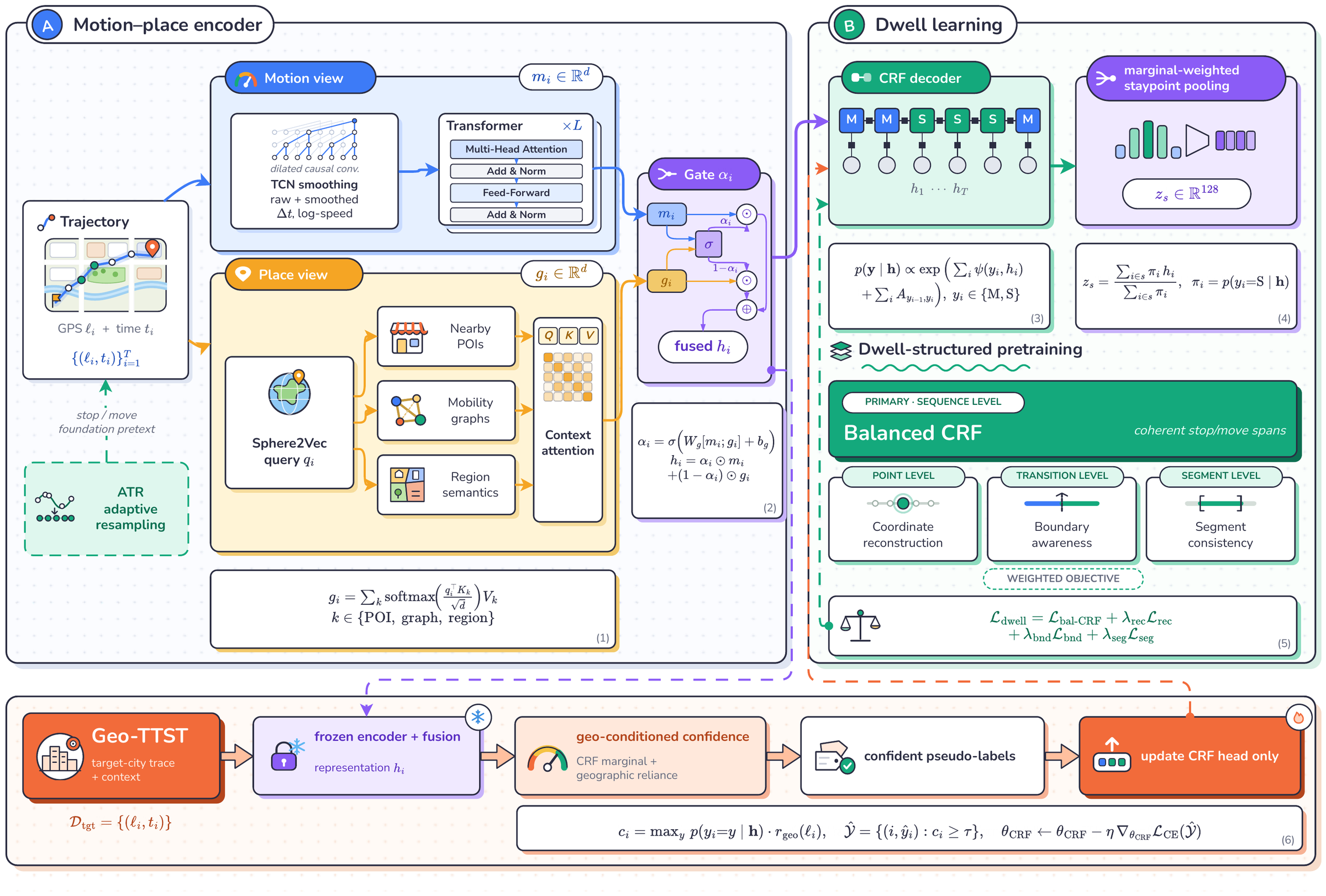
StayBERT: Staypoint Detection as the Pretext Task for Trajectory Foundation Models
StayBERT uses staypoint detection as the pretext task for pretraining trajectory foundation models. A gated motion-place encoder feeds a CRF decoder trained with dwell-structured objectives. Geo-conditioned test-time self-training then adapts the model to new cities without labels.
Foundation Models×Self-Supervised Learning×Trajectory Data Mining
* Equal contribution
Journal Manuscripts
-
Emory NSF REU
Structured MAGI with Warm Starts for Partially Observed Bayesian ODE Inverse Problems
Structured MAGI targets Bayesian ODE inverse problems with partially observed systems. Multi-task GPs denoise the data, a physics-informed network supplies initial estimates, and these warm-start MAGI’s HMC sampling for parameters and trajectories with uncertainty estimates.
Bayesian Inference×Physics-Informed ML×Inverse Problems
-
Under review · IEEE Journal of ICHI
Spatiotemporal Evidence Grounding for Vision–Language Parkinson Gait Assessment
The model scores Parkinson’s gait severity (UPDRS-gait) from 3D body motion and grounds each prediction in biomechanical evidence. Thirteen concepts modulate frozen motion tokens, pooling merges clips and views, and joint concept regression keeps predictions interpretable.
Vision–Language Models×Interpretable AI×Healthcare AI