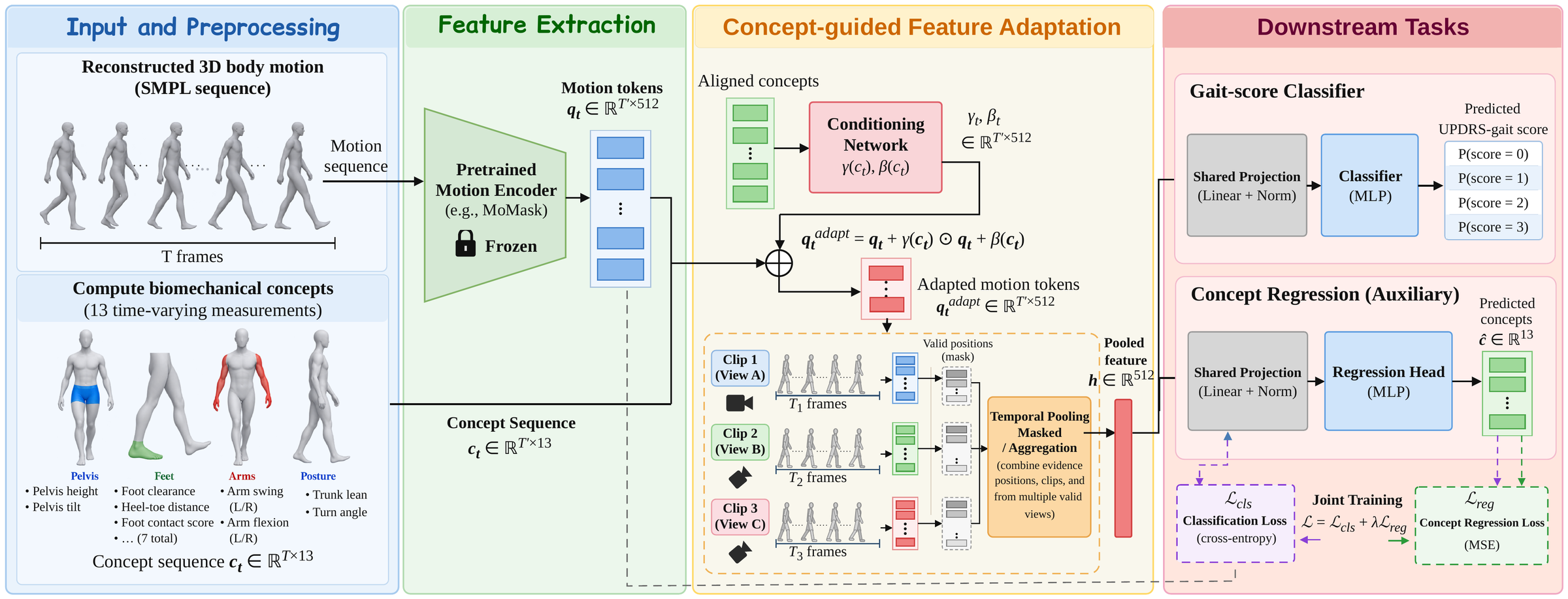
1Problem setup
Walking video is reconstructed into 3D body motion, from which two inputs are derived:
\[\begin{gathered}\mathbf{q}_t=\mathrm{Enc}_{\text{frozen}}(\text{SMPL motion})\in\mathbb{R}^{T'\times 512},\\ \mathbf{c}_t\in\mathbb{R}^{T\times 13},\qquad y\in\{0,1,2,3\}\end{gathered}\]
where
- \(\mathbf{c}_t\)
- thirteen time-varying biomechanical concepts: pelvis height and tilt; seven foot measures such as clearance, heel-toe distance, and contact; left and right arm swing and flexion; trunk lean and turn angle
- \(\mathbf{q}_t\)
- motion tokens from a pretrained motion encoder (for example MoMask) that stays frozen
- \(y\)
- the MDS-UPDRS gait score
2Concept-guided feature adaptation
\[\mathbf{q}^{\text{adapt}}_t=\mathbf{q}_t+\gamma(\mathbf{c}_t)\odot\mathbf{q}_t+\beta(\mathbf{c}_t)\]
where
- \(\gamma(\mathbf{c}_t),\ \beta(\mathbf{c}_t)\in\mathbb{R}^{T'\times 512}\)
- a per-token scale and shift produced by a conditioning network from the aligned concepts
- \(\odot\)
- element-wise product
The residual form keeps the pretrained representation unchanged when the concepts add nothing, and moves it toward clinically meaningful directions when they do.
3Evidence pooling across time, clips, and views
\[\mathbf{h}=\mathrm{MaskedPool}\Big(\big\{\mathbf{q}^{\text{adapt}}_{t,c,v}\ :\ t\ \text{valid},\ c\in\text{clips},\ v\in\text{views}\big\}\Big)\in\mathbb{R}^{512}\]
where
- \(t,c,v\)
- time position, clip, and camera view
- \(\mathbf{h}\)
- the pooled feature used by both heads
Masking ignores padded or invalid positions, so a patient recorded with fewer or shorter clips is not penalized.
4Two heads, trained jointly
\[\mathcal{L}=\mathcal{L}_{\text{cls}}+\lambda\,\mathcal{L}_{\text{reg}},\qquad \mathcal{L}_{\text{cls}}=-\log p(y^\star\mid\mathbf{h}),\qquad \mathcal{L}_{\text{reg}}=\mathrm{MSE}(\hat{\mathbf{c}},\mathbf{c})\]
where
- \(p(y\mid\mathbf{h})\)
- the gait-score classifier after a shared projection
- \(\hat{\mathbf{c}}\in\mathbb{R}^{13}\)
- the predicted concepts from the auxiliary regression head
- \(\lambda\)
- the weight of the concept term
The concept term keeps the shared representation tied to measurable gait properties, which is what lets each prediction be explained in biomechanical terms.
5Conclusion
Conditioning a frozen motion model on biomechanical concepts, and supervising those concepts jointly, gives gait-severity predictions that are grounded in the same measurements clinicians reason about.
Key references
- M. Loper, N. Mahmood, J. Romero, G. Pons-Moll, and M. J. Black. SMPL: A Skinned Multi-Person Linear Model. ACM Transactions on Graphics 34(6), 2015.
- C. Guo et al. MoMask: Generative Masked Modeling of 3D Human Motions. CVPR, 2024.
- E. Perez, F. Strub, H. de Vries, V. Dumoulin, and A. Courville. FiLM: Visual Reasoning with a General Conditioning Layer. AAAI, 2018.
- C. G. Goetz et al. Movement Disorder Society-Sponsored Revision of the Unified Parkinson’s Disease Rating Scale (MDS-UPDRS). Movement Disorders 23(15), 2008.