1Problem
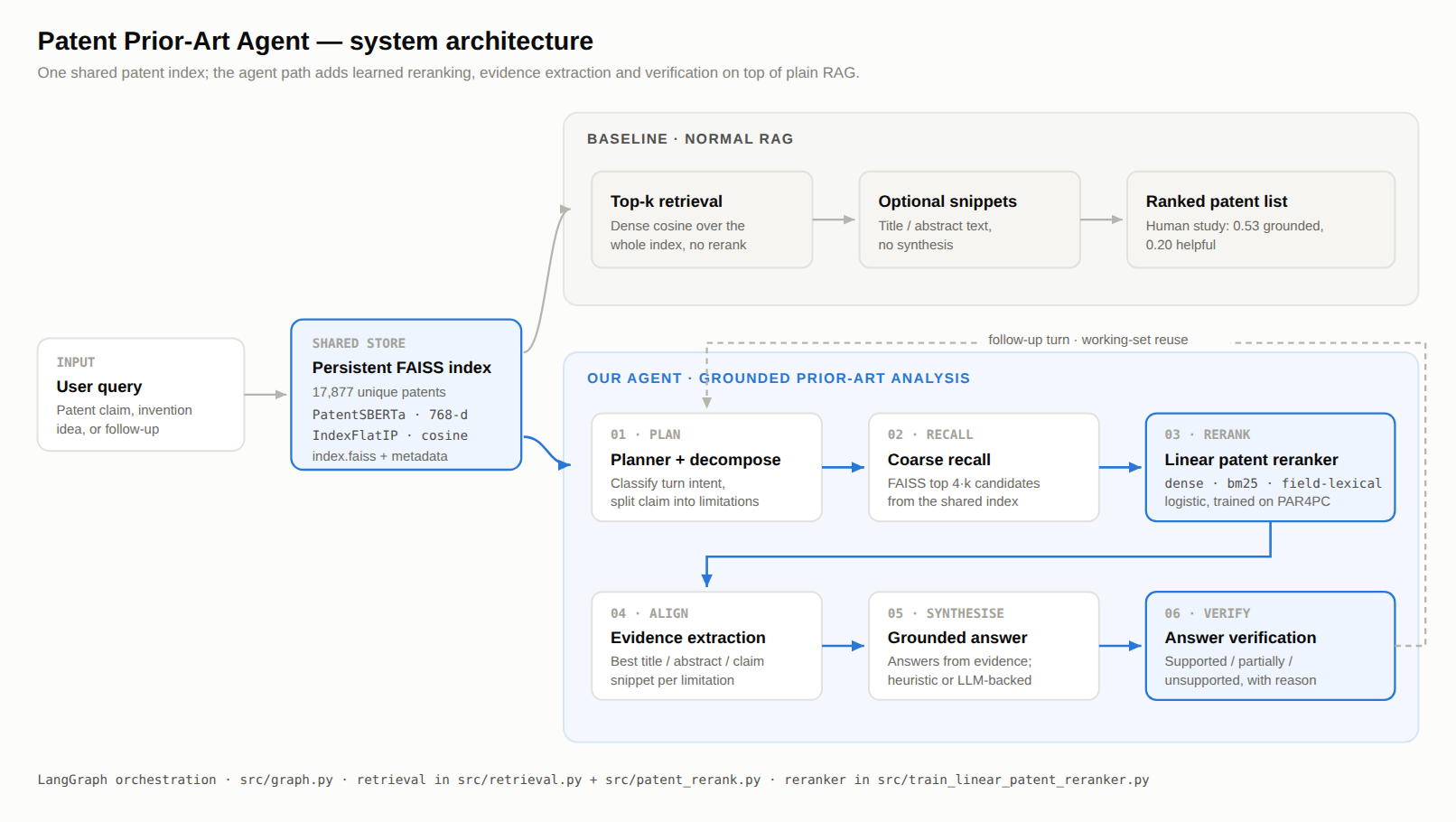
Given a patent claim, an invention idea, or a vague search query, the agent returns a ranked prior-art set, a limitation-level evidence chart, and an answer in which every statement traces back to retrieved patent text. Plain retrieval-augmented generation ranks by a single similarity and writes from whatever it retrieves, so it can neither rank by claim limitations nor show which passage supports which statement.
2Method
| Stage | Operation |
|---|---|
| 1 Plan | Classify the turn (new search, follow-up, comparison, filter) and decompose the claim into limitations \(\ell_1,\dots,\ell_m\). |
| 2 Recall | Coarse recall from a persistent FAISS index of 17,877 patents with 768-dimensional PatentSBERTa vectors. |
| 3 Rerank | Learned linear reranker over dense, BM25, and field-lexical scores (Eq. 1), trained on PAR4PC. |
| 4 Align | For each limitation, select the strongest title, abstract, or claim snippet (Eq. 2) and build the claim chart. |
| 5 Synthesize | Write the answer from the extracted evidence only. |
| 6 Verify | Label the answer supported, partially supported, or unsupported against the evidence, with a reason. |
For a query \(q\) and candidate patent \(d\), the reranker combines the three retrieval signals linearly:
with \(\mathbf{w}\) fit on PAR4PC. Evidence is then chosen per limitation over the fields \(f\in\{\text{title},\text{abstract},\text{claims}\}\) of each retained patent:
so every row of the claim chart, and every sentence of the answer, carries a pointer to a specific passage.
3Results
3.1 Prior-art ranking
| Method | Hit@1 | Hit@3 | Recall@3 | Exact@|gold| |
|---|---|---|---|---|
| BM25 (lexical) | 0.718 | 0.926 | 0.843 | 0.560 |
| PatentSBERTa (dense) | 0.714 | 0.950 | 0.885 | 0.570 |
| Learned reranker (ours) | 0.754 | 0.959 | 0.901 | 0.622 |
Finding. The learned reranker is best on all four metrics: Hit@1 rises from 0.718 (BM25) to 0.754, and Exact@|gold| by 5.2 points over the dense baseline (0.570 to 0.622).
3.2 Human evaluation
| System | Overall quality |
|---|---|
| Gemini Fast | 0.350 |
| ChatGPT Auto | 0.519 |
| RAG only | 0.581 |
| Patent agent (ours) | 0.906 |
Finding. The agent scores 0.906 against 0.581 for plain RAG over the same index, and reuses context across follow-up turns at 0.98.